

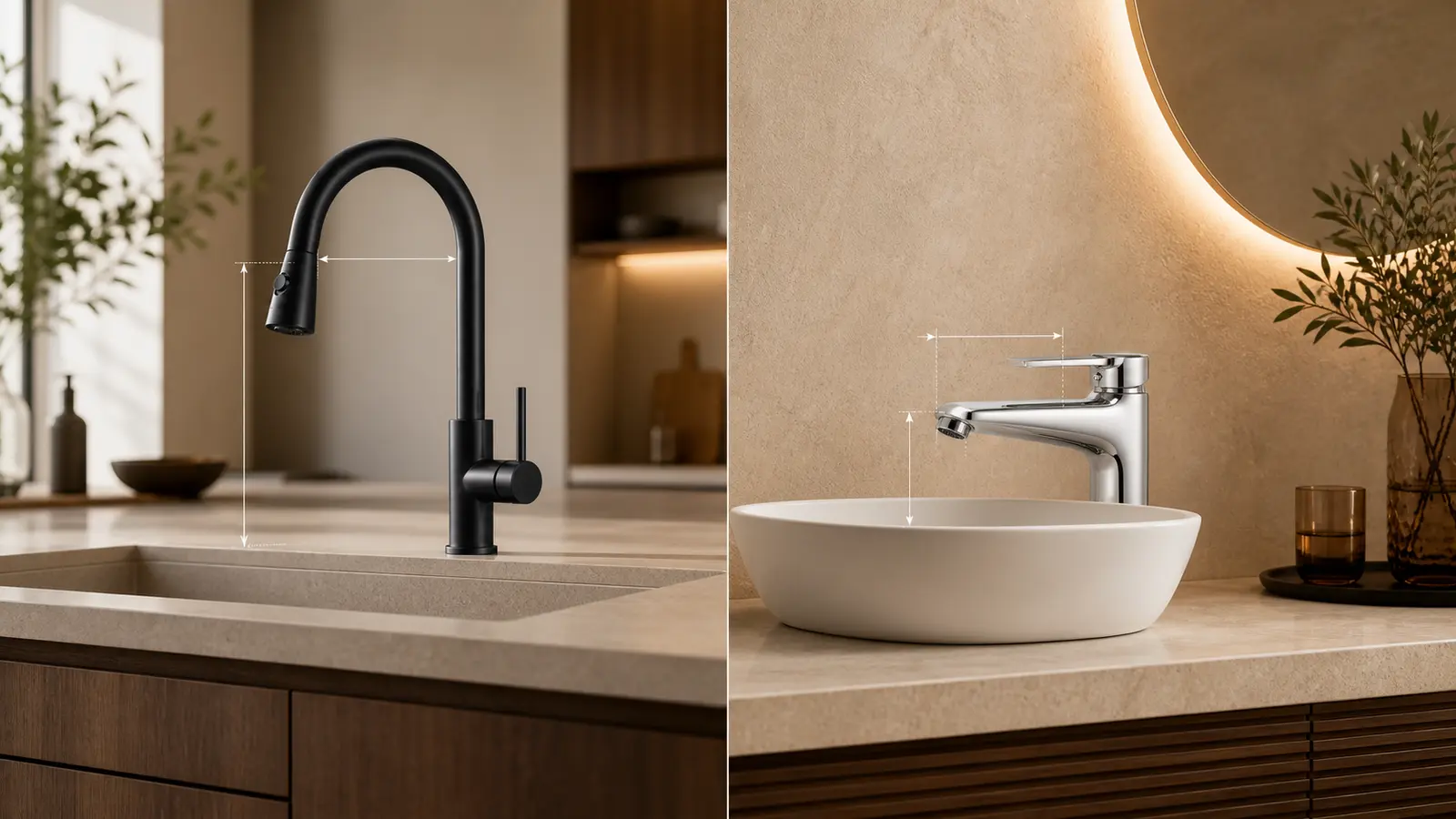
What is the best basin mixer for your needs?
Start with the basin and its mounting openings, then choose the finish, listed accessories and warranty that suit the order. A basin set into the worktop and a vessel basin above it need different checks of spout height and reach. The brand or warranty duration cannot replace measurements of the installation.
Actual Mafkat listings to compare
These examples compare the use, finish and listed components in our product records. They are not a quality ranking or performance test. Open each product page for its current final SAR price and availability, then review the warranty terms and package contents.
| Store option | What the listing establishes | Check before choosing | Listed warranty |
|---|---|---|---|
| KOONEE Chrome KM-6002 | Chrome finish; this listing does not include accessories | Compare spout height, reach and mounting opening; do not assume the black version's accessories belong to this order | One year against leakage, subject to its terms |
| DueGi Lugano DG1462-140 | Chrome, single lever and listed click-clack waste | Match the waste size and basin overflow arrangement, and confirm the included parts | No duration is stated in the current product copy; ask before ordering |
| Saudi Ceramics Tall Chrome Basin Mixer | Tall format and chrome finish | Measure the basin rim and mounting position; request spout outlet height and reach if not stated | Five years recorded by the store, subject to its terms |
| Saudi Ceramics CUBIST Tall Black Mixer | Matte black; listed height 25 cm | The listed fitting height alone does not establish outlet clearance above the bowl; check the installation drawing | Manufacturer lists ten years; check coverage and applicable terms |
The CUBIST height and warranty are supported by Saudi Ceramics' exact item 180101010121002. Other warranty and accessory information comes from the linked Mafkat listings; check the current terms and specifications when buying.
A shorter decision process
- For a mixer mounted in an inset basin, start by checking the spout and mounting opening of standard-format choices such as KOONEE or DueGi.
- For a vessel basin above the worktop, compare tall choices such as Saudi Ceramics chrome or black CUBIST against your measurements; the word tall does not confirm a fit.
- If you need a click-clack waste, check DueGi's included components and waste size rather than assuming every mixer includes one.
- After confirming the fit, compare the current final price, warranty terms and finish on the product pages. A higher price does not establish a better fit.
Buying, delivery and installation in Dammam and Khobar
Mafkat is an online store serving supported delivery areas in Dammam, Khobar, Dhahran and Qatif. The order address and service availability determine delivery eligibility. Installation options appear for eligible products under the service terms. Review current delivery terms and fees and installation conditions, then check the final price and selected options at checkout.
Browse basin mixers, or kitchen and sink mixers for kitchen use. Send photographs and measurements through Contact when an important fitting dimension is missing.
Measurements that decide compatibility
A mixer may look perfect in a photograph yet still be unsuitable for the sink, countertop or existing plumbing. Before buying a kitchen or basin mixer, check the installation and dimensions—not only the design and finish.
Product measurements and connections vary, so always compare your measurements with the specification or installation instructions for the exact model.
Identify the installation type
Start by determining where and how the mixer will be mounted.
- A deck-mounted mixer is fixed through the sink or countertop.
- A wall-mounted mixer connects to plumbing prepared inside or on the wall.
- A concealed mixer requires a compatible in-wall body, installation depth and trim set.
If replacing an existing mixer, photograph it from above and below before removing it. The visible base may hide more than one mounting hole.
A decorative deck plate can sometimes cover unused holes, but it does not correct unsuitable hole spacing, diameter or countertop thickness. Use only a plate approved for the selected mixer.
For a new sink or countertop, choose the mixer before drilling and follow the exact model’s installation measurements.
Measure the mounting area
Record:
- Number of mounting holes.
- Diameter of every hole.
- Centre-to-centre spacing between holes.
- Thickness of the sink or countertop.
- Distance from the mixer to the wall or backsplash.
- Available space below the sink.
Single-hole and multiple-hole mixers use different configurations. Even products that look similar may require different measurements.
For wall-mounted or concealed mixers, confirm the connection spacing, finished-wall depth and spout projection against the exact installation drawing. Concealed bodies and visible trim are not automatically interchangeable.
Check spout height and reach
Spout height is the vertical space below the outlet. Spout reach is the horizontal distance from the mixer’s mounting centre to the outlet.
The water should land comfortably inside the bowl, preferably near its centre or slightly behind it—not onto the rim or directly against a shallow side.
A spout that is too short can reduce usable hand-washing space. Excessive height or reach can increase splashing.
Check:
- Basin width and depth.
- Basin rim height.
- Clearance above the mixer.
- Distance from a wall, mirror, shelf or window.
- Space required for full handle movement.
An above-counter vessel basin usually needs a suitably tall mixer or a correctly positioned wall-mounted mixer. Measure from the finished mounting surface to the top of the basin rather than judging from a product photograph.
Check the space below the sink
There must be sufficient room for the fixing shank, retaining nut and supply hoses.
Pull-out kitchen mixers also need an unobstructed path for the hose and its weight.
Look for conflicts with:
- Drawers and cabinet shelves.
- Waste traps and drain pipes.
- Waste bins.
- Water filters.
- The underside of the sink.
- Drain operating rods.
Match the mixer to its use
A kitchen mixer should suit the sink and everyday tasks. A higher spout can make it easier to fill pots, but it still needs sufficient overhead clearance and a sink deep enough to limit splashing.
Consider a swivelling spout for a double-bowl sink and verify its turning range if a wall or window is nearby.
For a basin mixer, balanced proportions and accurate reach are particularly important. Confirm that the handle moves freely and that the water lands inside the bowl.
Do not use a kitchen or basin mixer as a substitute for a bath, shower or concealed mixer. These systems have different fittings and installation arrangements.
Verify plumbing connections
Before ordering, confirm:
- Whether the product requires hot and cold supplies.
- Inlet hose or thread type and size.
- Location and condition of shut-off valves.
- Manufacturer limits for water pressure and temperature.
- Included hoses, fittings, deck plate or drain parts.
- Availability of cartridges and replacement parts.
Do not assume that a hose will connect directly because it looks similar. An unsuitable adapter or forced thread can damage the connection and cause leakage.
Choose a practical finish
Choose compatibility and dimensions before selecting the finish.
Chrome is easy to coordinate. Matte black provides stronger contrast, while brushed finishes may reduce the visibility of some fingerprints and water marks.
Actual finishes can vary between manufacturers, even when their names are similar.
For routine care:
- Follow the manufacturer’s cleaning instructions.
- Use a soft cloth or non-abrasive sponge.
- Dry the surface after use.
- Avoid abrasive pads and strong acidic or bleach-based cleaners unless specifically approved.
Final checklist
Before ordering, confirm:
- Mounting location and type.
- Number, diameter and spacing of holes.
- Sink or countertop thickness.
- Spout height and reach.
- Basin dimensions.
- Handle, wall and window clearance.
- Space below the sink.
- Hot and cold inlet compatibility.
- Pressure and temperature requirements.
- Included installation accessories.
- Warranty and replacement-part availability.
A few accurate measurements before buying can prevent unnecessary drilling, unsuitable adapters, leakage and replacement costs. When uncertain, send Mafkat photographs of the sink from above and below together with your measurements before choosing a model.
Distinguish tap operation from waste operation
A basin waste may operate by pressing it or moving a lever. That does not mean the tap itself has a sensor. Check the exact model’s water controls and package contents.
Technical references
- hansgrohe: basin-and-tap compatibility, usable clearance and splash testing.
- hansgrohe: Vernis Blend 71552000 illustrates model-specific data; it is not a recommendation to buy that model or evidence for other products.
- GROHE: the Allure catalogue illustrates different mounting arrangements and package requirements.
hansgrohe — Tap and wash basin, perfectly coordinated
hansgrohe — Vernis Blend 71552000
GROHE — Allure catalogue, page 23
Apply the comparison to two specific models
For the HESANIT Sky 5001 chrome basin mixer, the manufacturer lists a 123 mm projection and a flow rate of 5 litres per minute at 3 bar. For the HESANIT Sky 5005 chrome kitchen mixer, it lists a 183 mm projection and deck mounting. These are two different models serving different uses, not dimensions to apply to every tap or another finish.
Compare the projection with the position of the mounting hole in your basin or sink. Request spout height and connection sizes if they are not shown. A taller tap or a longer spout is not automatically a better fit. Match the model reference on the package when ordering.
Choose the category that matches your sink
Browse basin mixers for bathroom options or kitchen sink mixers for kitchen models. If you need a pull-out head, review the HNH pull-out kitchen mixer and confirm space for the hose below the sink; a pull-out function does not establish mounting-hole dimensions.
Sources for the two examples: HESANIT Sky 5001 and HESANIT Sky 5005. Check each product page for current availability, price and supplied accessories.
- kitchen mixer
- basin mixer
- faucet compatibility
- mixer measurements
- خلاط مطبخ
- خلاط مغسلة
- مقاسات الخلاط