

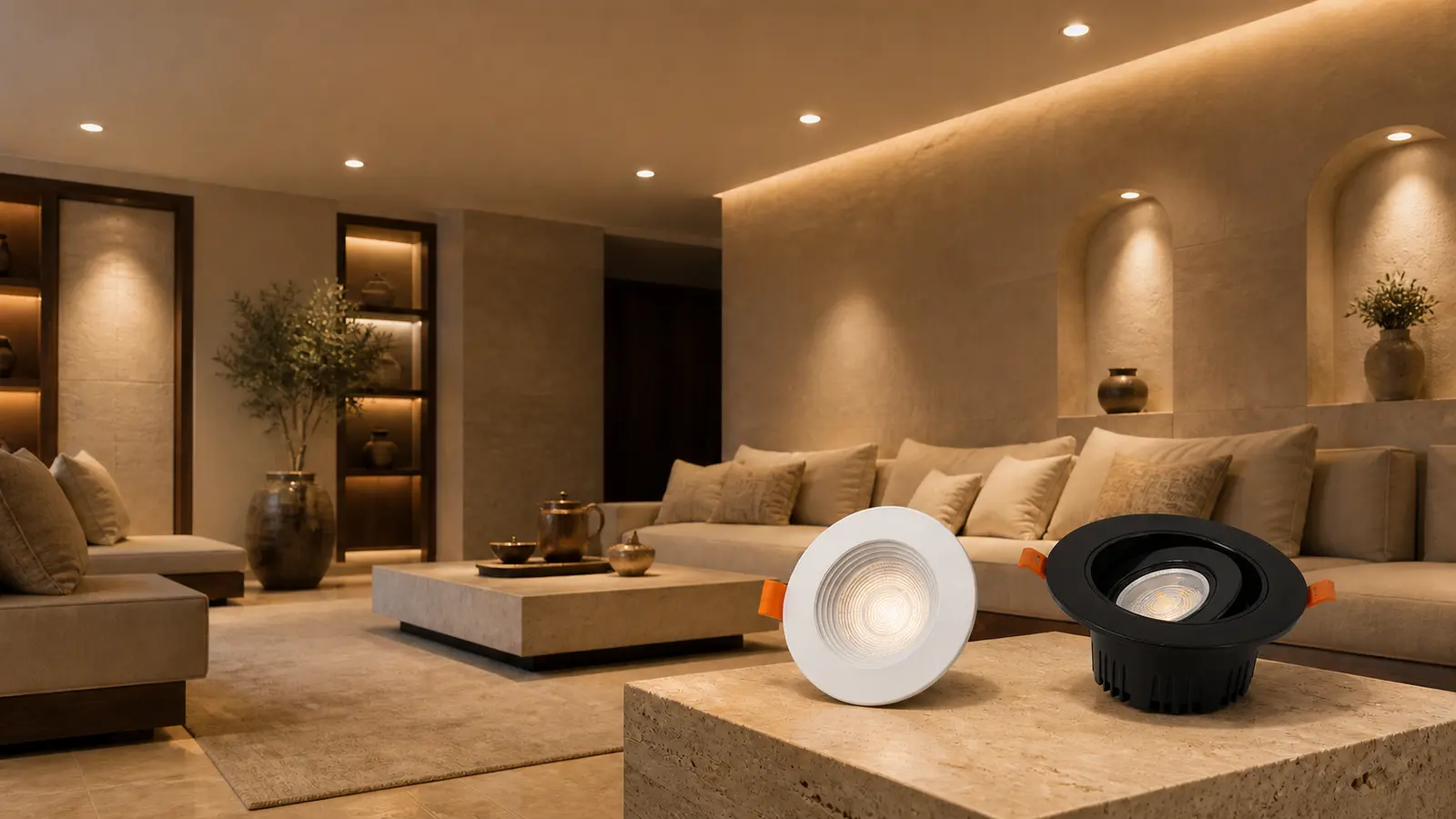
Choosing a recessed LED downlight involves more than matching a wattage or selecting an attractive design. The right fitting should match the ceiling opening, provide suitable light for the room, control glare and be approved for its installation location.
Use this guide before cutting a new ceiling opening or replacing an existing downlight.
Start with the purpose of the light
First decide what the light needs to do.
- General lighting provides comfortable illumination across the room.
- Task lighting adds focused light over worktops, desks, mirrors and preparation areas.
- Accent lighting highlights artwork, shelves, wall finishes or architectural details.
- Adjustable spotlights direct light toward a chosen surface.
A living room or majlis may combine warm general lighting with a few adjustable accent lights. A kitchen may need broad general lighting together with focused light over preparation areas.
Check the ceiling and installation type
A recessed downlight sits inside a ceiling opening. It needs enough space above the ceiling for the fitting, driver, wiring and any clearances stated by the manufacturer.
A surface-mounted fitting attaches below the ceiling. It may be more suitable where there is no suspended ceiling, the ceiling void is shallow or cutting an opening is not practical.
When replacing an existing light, record:
- The diameter of the ceiling cut-out.
- The visible outer diameter of the fitting.
- The available depth above the ceiling.
- The dimensions and location of the LED driver.
- Whether ceiling insulation is present.
The cut-out diameter is not necessarily the same as the visible outer trim. Always follow the installation measurements for the exact product instead of estimating from its photograph.
Compare brightness using lumens
Watts measure electrical power consumption. Lumens measure the amount of visible light produced.
Two LED downlights with the same wattage can produce different amounts of light, so wattage alone is not a reliable brightness comparison.
The required brightness depends on:
- Room dimensions and ceiling height.
- Dark or light wall and floor finishes.
- Available daylight.
- The activities performed in the room.
- Beam angle and spacing between fittings.
- Other light sources in the space.
Check the stated lumen output whenever it is available. Plan the lighting around the room and its furniture rather than arranging lights only as decorative rows.
Choose a suitable color temperature
Color temperature describes whether white light looks warm, neutral or cool. It is measured in Kelvin.
- 2700K to 3000K gives a warmer appearance commonly suited to bedrooms, living rooms, dining areas and majlis spaces.
- 3500K to 4000K gives a more neutral appearance that can suit kitchens, wardrobes, utility areas and workspaces.
- 5000K and above appears cooler or more blue and should be selected deliberately when that appearance is required.
Try to use one color temperature across connected areas visible together. Mixing noticeably different whites in the same view can make the ceiling look inconsistent.
Consider CRI, beam angle and glare
The Color Rendering Index, or CRI, describes how faithfully the light presents colors.
A CRI of 80 is a useful baseline for general indoor lighting. Consider a higher value where color appearance is important, such as kitchens, wardrobes, makeup areas and detailed interior finishes.
A narrow beam concentrates light on a smaller area and can be useful for accent lighting. A wider beam distributes light across a larger area and is usually easier to use for general illumination.
A bright LED source can feel uncomfortable when viewed directly. Deep-recessed, baffled or anti-glare designs reduce direct visibility of the light source, which is particularly useful in seating areas and long sightlines.
Check moisture and electrical compatibility
For bathrooms, kitchens, balconies and other areas exposed to moisture, confirm that the product’s stated location or IP rating is suitable for its exact installation position.
Do not assume that a fitting is suitable for damp or outdoor use based on its appearance.
Before buying, verify:
- Rated voltage and frequency.
- Whether a separate driver is required.
- Whether the driver remains accessible after installation.
- Whether the product supports dimming.
- Which dimmers are compatible.
- Manufacturer requirements for ventilation and insulation clearance.
- Warranty and replacement terms.
Not every LED driver is compatible with every dimmer. An unsuitable combination may cause flickering, noise or unstable dimming.
Electrical installation should be carried out by a qualified professional in accordance with the manufacturer’s instructions and applicable Saudi electrical requirements. Power must be isolated before installation or maintenance.
Final checklist
Before ordering, confirm:
- General, task or accent lighting purpose.
- Recessed or surface-mounted installation.
- Ceiling cut-out and installation depth.
- Lumen output and wattage.
- Color temperature.
- CRI.
- Beam angle.
- Fixed or adjustable direction.
- Glare-control design.
- IP rating and approved location.
- Driver and dimmer compatibility.
- Warranty.
The best downlight is not necessarily the one with the highest wattage. It is the one that fits the ceiling correctly and produces the appropriate amount and quality of light.
- recessed lighting
- LED downlights
- indoor lighting
- spotlights
- ceiling lighting
- إضاءة داخلية
- داون لايت
- سبوت لايت
- كشافات دفن